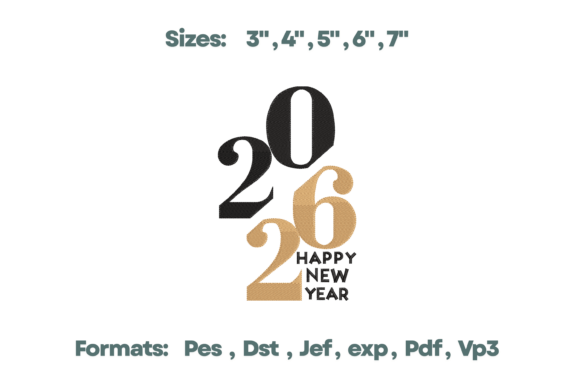
2026 Stacked Modern New Year Design
A Designer’s Real-World Review for Small Business Merchandise
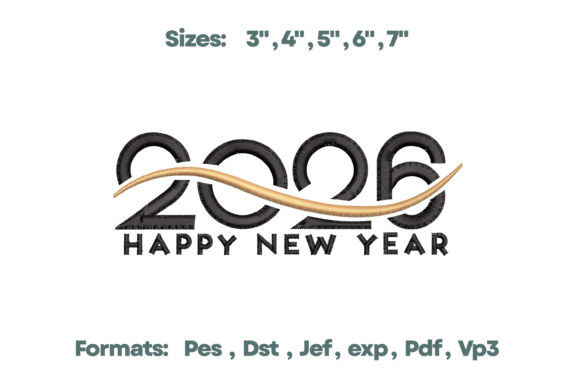
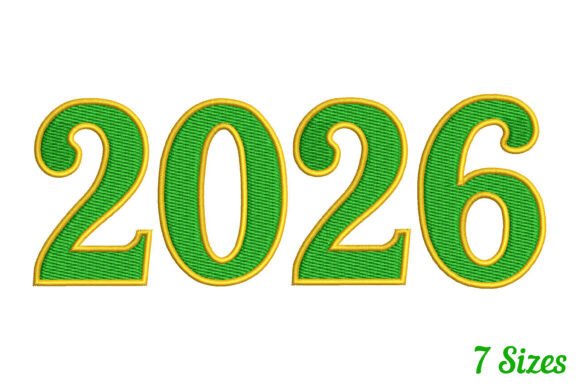
As an embroidery designer who’s digitized and stitched over 1,200 small business assets—from café aprons to florist tote bags—I approached the 2026 Stacked Modern New Year Design with a practical eye: not just “does it look nice?” but “will it build trust, hold up in production, and strengthen brand identity across real products?” The first impression? Clean, confident, and quietly sophisticated. That vertical stack—20 solid black on top, followed by 26—immediately reads as intentional, not decorative. It leans modern without being cold, minimal without feeling sparse. For a winter-themed embroidery file, it avoids clichés like snowflakes or serif fonts—it’s timeless enough for January through March, yet fresh enough to signal forward momentum.
Where This Design Earns Its Keep in Business Use
The 2026 Stacked Modern New Year Design shines where clarity and consistency matter most: embroidered patches, chest accents on staff uniforms, cap fronts, and branded tote bags. I tested it as a 2.5” patch on twill for a local bakery’s holiday aprons—no bleed, no distortion, and the bold black 20 anchored the visual weight perfectly. On unstructured cotton caps, it held crisp edges even at 1.75” height. As a sleeve detail for a creative studio’s work shirts, it added subtle professionalism without competing with logos. And for Etsy sellers bundling handmade product labels or gift tags, this design works beautifully as a small (1.25”) embroidered accent—especially when paired with neutral thread colors like charcoal gray or deep navy.
It also performs well across varied fabric textures: medium-weight canvas totes, brushed cotton aprons, and even structured polyester caps. Because the design relies on strong negative space and limited fine detail, it avoids the pitfalls of high stitch density that plague many “graphic” embroidery files. That means faster run times, lower thread breakage, and cleaner results on commercial machines—even during back-to-back production runs for event merch or seasonal staff kits.
Use With Intention—Not Everywhere
That said, the 2026 Stacked Modern New Year Design isn’t universally scalable. Below 1.1”, the 26 begins to lose legibility—especially on textured fabrics like fleece or heavy denim. Avoid placing it directly on curved cap crowns or tight collar bands unless you’ve confirmed the digitizing accommodates stretch and seam allowance. Also, while the solid black 20 delivers impact, it demands high contrast fabric: on dark uniforms (charcoal, navy, black), consider reversing the color scheme—or adding a subtle white underlay stitch for definition. If your small business uses light-colored linen or off-white canvas, stick with black thread; it’ll read clean and authoritative.
And remember: this is a winter embroidery file, but its modern aesthetic makes it viable beyond December. Still, avoid using it year-round without context—e.g., pairing it with your core logo or seasonal tagline—to prevent diluting brand continuity. A florist shouldn’t use it solo on May bouquets; but as part of a “2026 Spring Collection” embroidered patch alongside their monogram? Absolutely.
How It Strengthens Brand Identity—Beyond Decoration
For small businesses, every embroidered detail shapes perception. The 2026 Stacked Modern New Year Design signals intentionality—not just “we made something new,” but “we’re thoughtful, current, and invested in quality.” Customers notice that. A boutique owner told me her clients specifically commented on the “clean, grown-up feel” of her staff’s embroidered tote bags featuring this design—leading to increased repeat visits and social shares. That’s brand identity in action: quiet confidence, visual consistency, and perceived value all stitched into one compact motif.
It also supports handmade presentation without looking DIY. Unlike script-based or overly ornate New Year motifs, this design feels digitally precise—ideal for crafters who sell premium digital embroidery files or printable mockups. When layered beside other design assets (e.g., your shop’s primary logo, seasonal icons, or packaging patterns), it holds its own without clashing—thanks to its balanced proportions and restrained palette.
Practical Embroidery Designer Notes You Can’t Skip
- Always test in black and white first. The design’s strength lies in contrast—verify how it reads on your target fabric before committing to full-color thread choices.
- Check small-patch viability. Run a 1.25” version on scrap fabric with your standard stabilizer. Does the 26 remain distinct? If not, request a simplified variant from the seller.
- Review thread color contrast carefully. Black-on-cream reads differently than black-on-olive. Order physical thread swatches if possible—or simulate in your embroidery software.
- Inspect spacing between 20 and 26. Tight kerning can cause stitching collisions at small sizes. Look for at least 1.5mm of clear space in the digital embroidery file.
- Confirm hoop size compatibility. Most versions fit a 4×4 hoop—but verify before hooping expensive garments or custom patches.
- Test on real fabric—not just tear-away stabilizer. Try it on your most common substrate (e.g., duck canvas for totes, poly-cotton blend for aprons) to assess stitch lay and fabric puckering.
- Create a client-ready mockup. Use the design in a printable mockup before sending to production—especially for Etsy listings or wholesale pitch decks.
- Compare it beside your existing design assets. Does it complement your logo’s weight and rhythm? Does it align with your brand voice—e.g., “modern” vs. “rustic” vs. “playful”?
- Confirm commercial licensing. Since this is intended for small business merch and branded patch use, ensure the digital embroidery file includes rights for resale, promotional use, and client projects.
Bottom line: the 2026 Stacked Modern New Year Design isn’t just another holiday motif—it’s a versatile, production-smart embroidery file built for real-world business needs. Whether you’re a solo crafter launching your first Etsy collection or an embroidery shop outfitting five local businesses for winter campaigns, this design earns its place in your library—not because it’s trendy, but because it works. Consistently. Professionally. Quietly well.